Coldwell Banker R.M.R. Real Estate, Brokerage

Coldwell Banker R.M.R. Real Estate, Brokerage

Tuesday, 11 October 2016

Real Estate Trends for Buying or Selling

Surprising Real Estate Trends that Will Shape the Way You Buy and Sell a Home

When buying or selling a house, one of the first questions that come to mind is either “What do I want in a house?” or “What do buyers want in my house?” The answer to either question may have a surprising link to generational real estate trends.

When buying or selling a house, one of the first questions that come to mind is either “What do I want in a house?” or “What do buyers want in my house?” Though it can be hard to differentiate between wants and needs in real estate, the answer to either question may have a surprising link to generational real estate trends.
The Data
According to data on home buyer and seller generational trends released by the National Association of Realtors, Millennials (those born between 1982 and 2000) continue to comprise the largest contingent of homebuyers, holding 35 percent of the market. Although Millennials are the largest contingent of homebuyers, they spend less time saving for a down payment and have the largest level of educational debt than their home-buying counterparts. The next largest contingent, at 26 percent of the market, is made up of Generation X (those born between 1965 and 1981). These buyers have had a bit more time to pay down student debt, save for a down payment, or gain some equity in their current home — which can provide clues about home buying trends based on age.
Millennials
Millennials are more likely to look for a bargain, with affordability trumping almost every other housing need, and it is one of the major reasons Millennials are flocking to the suburbs, as opposed to urban areas. When selling, that means appealing to the Millennial set that will be looking for walkability, transport links, and neutral spaces to put their stamp on. If buying, especially for the first time, Millennials are more likely to compromise on the size and age of a home before they compromise on price, which provides ample opportunity to build equity through a renovation before moving on to a larger home in the future.
Generation X
Gen Xers, on the other hand, are more likely to move to obtain a larger home for their growing families. When selling, this means playing up livable space in a home and demonstrating how it can support a growing family. Items to focus on are the main living spaces such as the kitchen, living areas, and bathrooms. Proximity to good schools and transportation routes are also good qualities to play up. Gen Xers are also more likely to stay in their homes for a longer period than the Millennial set — meaning Xers are more likely to compromise on price to get the right neighborhood or location.
Baby Boomers
If you’re wondering where the Baby Boomers fit in, it may surprise you to know that the Millennials have recently surpassed Baby Boomers as America’s largest generation, and this demographic shift is reflected in their share of the real estate market. With many Boomers still in the workforce, the real estate trends for this group have been split in two: younger Boomers (born between 1956 and 1964) and older Boomers (born between 1946 and 1955). They have a market share of 16 percent and 15 percent of the market respectively. What makes this generation unique is that they are the ones most likely to move the furthest, obtaining a smaller home and relocating closer to family and friends, and they are willing to pay for the location they want.
The Bottom Line
Across all buying groups, environmentally friendly features ranked as incredibly important, and nearly all generational groups from 30 to 90 began their real estate search online — something potential home sellers should be aware of when preparing their home for sale. No matter who your target market is when selling your home, presenting a neutral space, playing up the local amenities, and including lots of pictures in an online listing will remain critical in a successful sale.


Friday, 7 October 2016

October Home Checklist

To-Dos: Your October Home Checklist

Clean up fallen leaves and branches and get your home ready for more time spent indoors.

houzz logo
Houzz Contributor, Laura Gaskill
The leaves are falling, the farmer’s markets are bustling and the cozy comforts of home beckon — it must be October. Make the most of this month’s bountiful harvest, get some exercise raking leaves in the brisk air and button down your house in preparation for winter. Then sit back, relax and warm your hands around a mug of hot apple cider. Fall is here.
Connor Homes - The Dorothea Harwell House
1. Rake leaves. To make quicker work of collecting leaves from a large lawn, rake the fallen foliage onto a large plastic tarp. Then bag it or add it to your compost pile.
2. Trim dead tree limbs. Dead limbs are more likely to fall during winter storms, making them a potential safety hazard. Have an arborist inspect and trim large trees.
3. If you haven’t already, clean gutters and downspouts. Wait until most of the leaves have fallen to schedule a rain gutter cleaning. Inspect gutters and downspouts for cracks and loose parts and make repairs as needed.
Leschi Remodel
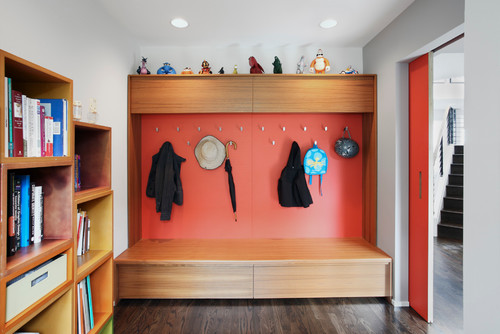
4. Neaten up the mudroom. The back-to-school (and work) flurry can leave the mudroom looking as if a hurricane hit it. Take some time to regain sanity — sort through papers and put away stray summer items and extra coats. Clean the floors and invest in a new doormat if needed. Keep a recycling basket near the entrance to make sorting mail and school papers easier, and dedicate a tote or bin for items that need to be returned (like library books).
Brookline
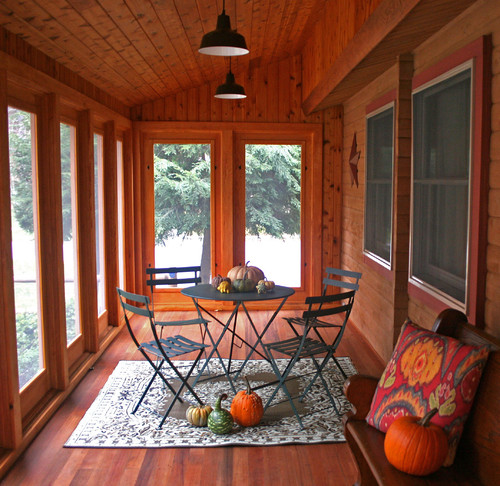
5. Keep seasonal decorating low-key with natural finds. Pumpkins and gourds, fresh heirloom apples, quinces, pomegranates, figs and fall foliage all make wonderfully simple decor.
Bring in cut branches from your yard, stop by a pick-your-own farm or scoop up fall’s bounty at a farm stand.
Stackyard House
6. Maintain your wood stove or fireplace. If you have a fireplace or wood stove, it’s essential for safety that you have it serviced before lighting the first fire of the season. If you haven’t done so already, schedule an appointment to have your chimney inspected and, if necessary, cleaned.
Farmhouse Yellow
7. Check safety devices. Test all smoke and carbon monoxide detectors in the house and replace batteries as needed. Check the expiration date on the kitchen fire extinguisher and replace it if needed.
2015 Kosair Children
8. Start a gift list. It may seem like the holidays are a long way off — but that’s why it pays to start getting organized now. Start a list of everyone you plan to give gifts to this year. Then, as ideas strike, jot them down on your list. You can also use your list to keep track of a holiday gifting budget. And if you want to make any gifts by hand, October is a great time to get started — handmade gifts always seem to take longer to make than expected.
Alderwood Landscape
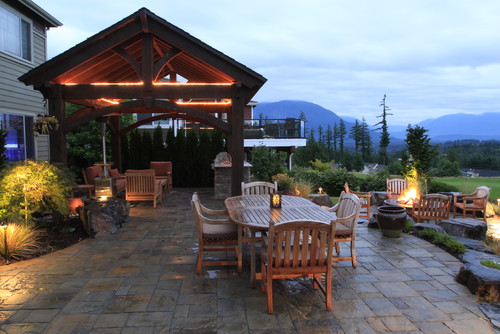
9. Cover or store outdoor furniture and grills. If you plan to leave your patio furniture or grill outside through the fall and winter, cover them well and stow them beneath an overhang that will protect them from rain and snow. Even if you live in a mild climate, covering your grill between uses is a good idea to protect the finish.
Cherry Street Residence
10. Shut off exterior faucets and store hoses for winter. Disconnect, drain and roll hoses before storing them for the winter. Shut off the water supply to exterior faucets to prevent frozen pipes.
Tell us: What’s on your to-do list this October?
Related Links:

Tuesday, 4 October 2016

Coldwell Banker's Ultimate Service®

Real Estate Consumers Want An Ultimate Service®

In today’s marketplace, Canadian consumers are constantly being inundated with advertising claims from a number of real estate brands, many of which sound very similar from one company to the next.  The consumer is left wondering whether there really is a difference between real estate companies.      

That was a key reason why Coldwell Banker developed Ultimate Service®.  It all starts with listening.  Every customer and every transaction is different.  Only by listening to the customer and truly understanding their individual needs, can you deliver a value proposition that will meet those needs.  

There are three distinct steps to the Ultimate Service marketing process:
-- First, we listen to the customer, to understand their needs and goals.  
-- Second, -- together with the customer -- we develop a customized service plan to meet their needs…and then commit to that service plan, in writing.  We offer a signed pledge to customer satisfaction in the form of our Buyer and Seller service guarantees 
-- And finally, we give our customers an opportunity to evaluate our service in the form of customer satisfaction surveys.  

These satisfaction surveys benefit the consumer in two ways.  First, it provides valuable feedback which allows us to continually evaluate and refine our service offering.  Only by constantly improving can you ensure that your service stays ahead of your customers’ expectations.  

But there’s another way that our survey benefits the consumer - it offers them a proven track record of our performance.  In fact, Coldwell Banker Canada has just earned a 98% overall satisfaction rating from Canadian Home Buyers and Sellers.  And what’s more, we’ve now done it for 14 years in a row! 

This satisfaction rating is unique in the real estate industry.  Why?  Because it’s based on what real, live customers had to say about the service experience delivered by their Coldwell Banker professional.  This 98% satisfaction rating was tabulated by an independent third party company, and is based on the responses of over 55,000 Canadian home buyers and sellers.  No other company in real estate can make that claim.


When you choose Coldwell Banker, you don’t have to take our word for it that we provide outstanding service – just ask our customers!   

Wednesday, 21 September 2016

Basic Home Improvements

With prices on mostly everything increasing, bigger chunks are being taken out of our wallets every day.  You could save money on your home bills with a few home improvements.  Some improvements that help you save can actually add to the value of your home.

Two areas that you may be able to save are your Hydro and Water Bills.

Hydro:
There are many ways to save on your hydro bill.  You may have switched to compact fluorescent light bulbs already but there is more you can do.    Technology on L.E.D. light bulbs has come along way.  They are now cheaper to purchase and the look and colour of the bulbs is now equivalent to traditional incandescent bulbs.  You can find them at your local hardware of home improvement store.

Manage the temperature inside your house with a programmable or smart thermostat.  A programmable thermostat helps save energy and money by scheduling temperature settings for when you are likely to need heat and air conditioning.  A smart thermostat can be set to know when you are on your way home and have your home at the temperature you want when you arrive home.

If your home won't stay warm in winter and cool in the summer check your windows and doors.  Drafty windows can cause a big chunk of your heating and cooling losses.  You can apply new weather stripping to windows and doors to close up the leaks.  If you have older windows you may need to apply clear shrink film over the window which will add an extra barrier around the window preventing heat loss in the winter.

Installing timer switches that turn the lights (or exhaust fans) off after a predetermined amount of time can also help to save you money by not having lights and fans run while your not in the room.  Occupancy sensing light switches are also available.  These will detect if anyone is in the room or not and turn the lights on or off accordingly.

Ceiling fans can drastically help air flow throughout  your home, helping your furnace or air conditioner heat or cool more efficiently.

Your furnace filter is a very easy way to help your furnace perform how it was designed.  In the spring and fall replace the filters before you need to cool or heat your home.  Replacing the filter will also collect dust and dirt making your home cleaner and healthier.


Water:
Showering and bathing comprises 35% of Canadian household water usage.   You can install low flow shower heads and faucets which can dramatically decrease your water consumption.

Fix any leaky faucets and pipes to decrease your water bill.  If leaks are not repaired you could require more expensive repairs down the road.  A good habit to get into is to check your faucets and pipes for wear and tear every six months.  If you notice a leak have it fixed right away.

When doing your laundry and dishes, wait till the off peak hours of the day.

How old is your hot water tank?  New hot water tanks are much more efficient.  Consider a tankless water heater.  It may help save you money and the bonus is you will never run out of hot water again.